
Rainbow Parade, Auckland
I liked that old name for the parade – Hero. I liked how it flipped our usual understandings of a word. And I liked how it reminded us of the bravery of those who are Queer. For those who love another, at the risk of being subjected to all manner of discrimination.

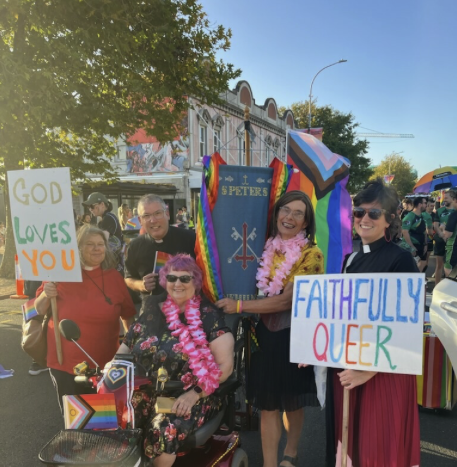
In an earlier time, when the Auckland Rainbow Parade was known as the Hero Parade, I was interviewed by a conservative Christian newspaper called Challenge Weekly. Face-to-face with me the earnest interviewer was perplexed. She could not understand how someone who was heterosexual, or in her words “married with children”, could support and advocate for the rights of those who weren’t. I suspect she had never met such a heterosexual person. Which even 30+ years ago surprised and saddened me.
In my lifetime there has been significant change. I remember a parishioner back then, who after the death of his partner of some 20 years, was prohibited by his partner’s family from attending the funeral. Further, they took all his assets, including his home and business. Which, as you can imagine, was loss upon loss, pain upon pain, for this man.
In 1986 the Homosexual Law Reform Bill decriminalized same-sex consensual relationships, and as hugely important as that legislation was, it wasn’t until the Property (Relationships) Amendment Act 2001 that such justice, that this parishioner never knew, was available.
A lot has changed in my lifetime.
I remember, and advocated for, the passing of the 2004 Civil Union legislation and the 2013 Marriage (Definition of Marriage) Amendment Act, allowing for same-gender marriage and adoption rights. I remember too how most churches and their leaders opposed these changes.
It is easy to forget what it was like back in the late ‘70s and early ‘80s. Unless you were a recipient of the vitriol. Unless police officers knocked on your door. Unless were convicted for loving another. Unless you lost your job or property or immigration status. Unless you were beaten up for the crime of being different.
As a minister I have, time and again, heard stories of parishioners being beaten up. Which, as I said to that Challenge Weekly reporter, I’ve struggled to understand. I can understand uncomfortably, even apprehension, when we first meet someone who is different from ourselves. But anger? And anger that needs to be expressed in violent acts? I’m at a loss to understand why difference is so threatening, and where this heterosexual anger is coming from.
And yet, comes it does. And still comes.
Which is a question for churches who still discriminate. Why are you so angry about same-gender love, about Queer rights and belonging? What about the ‘sin’ of greed, which the Bible is so much more vocal in condemning? Why aren’t you angry, and violent even, towards the greedy? (Not that I’m encouraging a destructive anger or violence. Just asking a question of why.)
I liked that old name for the parade – Hero. I liked how it flipped our usual understandings of a word. And I liked how it reminded us of the bravery of those who are Queer. For those who love another, at the risk of being subjected to all manner of discrimination. For those who though wary of self-expression, and the anger in others it can elicit, do it anyway. For those who know the isolation that comes from being different and strive daily to overcome their fears.
I could have answered that Challenge Weekly reporter with an answer grounded in the Bible and theology, an answer about justice and love for all people. But on a deeper level the answer is personal. It is highly likely that for those of us “married with children” there will be among our children, or grandchildren, or their descendants, some who identify as Queer. It will be a member of our family discriminated against. ‘They’ are us.
And, what’s more, we can aid now in stopping that discrimination, that anger and violence, by addressing its causes and building cultures, communities, and churches of love, justice and inclusion. We can build a different future.
The last 40 years has taught us that. It’s also taught us there is still a way to go.
Glynn
(Image: from the Auckland Rainbow Parade 2026, members of St Peter's Onehunga with friends)


