
Resurrection Fables: What’s the moral point?

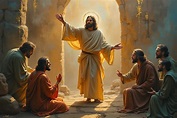
Fable: afictitious narrative, such as a legendary story of supernatural happenings, designed to teach a specific moral lesson.
This season of Easter, which in the Church calendar concludes after 40 days on the Feast of Ascension (last Thursday), invites us to read again the stories ofJesus’ post-death, apparition-like encounters with his disciples. These are called, in scholar-speak, the appearance narratives.
Today I want to invite you to consider the three such narratives where the apparition(or in scholar-speak ‘the Risen Christ’ or simply ‘the Christ’) is at first unrecognizable. All three are only recounted once – The Emmaus Road in Luke, and The Garden and The Lakeside in John.
Secondly, I would like you to think of these three narratives as fables, and using our imagination and experience ask what might be the specific moral lesson (rather than theological lesson) each might teach. A moral lesson essentially being about how we might live, rather than a theological lesson being essentially about God.
But firstly, my motivation in doing so:
With the fixation on a literal physical resurrection of Jesus in many churches, it's tempting to wish all the Gospels had ended like Mark's original. That is, an ending where no dead body has come back, literally, to life.
Yet I'm not tempted. For it plays into the hands of those who want to make faith into a fact, an equation, an absolute certainty. Apologists for the dead-body-come-alive thesis use it for this end. The claim that 'Jesus is alive' (literally) is used as the ultimate proof of the Christian God. The sign of all signs, the miracle if all miracles. So, they say.
And apologists for the (to quote Lloyd Geering) 'his bones are buried in Palestine 'thesis (although I think this is more likely) also slide into this mire of faith needing to be provable. Provable that is by using accepted historical or philosophical method. Provable to counter the supernatural claims of the literalists, and make religion real to life.
Though I admire the rigor of some such historical and philosophical thinking, I want to hold to an understanding of faith that allows plenty of room for the imagination, for what Niki Harré calls ‘enchantment,’ namely the capacity to see coincidence and beauty combine.
And I also want to ask the question ‘So what?’ Does a literal resuscitated Jesus, who allegedly wandered Palestine for 40 days after he died, make any difference to how we might live? The older I get the less I am concerned about belief and the more I’m concerned about behaviour – personal, social and political (which of course is influenced by belief). So, what do the Jesus apparition accounts say about behaviour?
The resurrection appearance narratives (of Matthew, Luke, and John) in all their inconsistencies, magical thinking, and individual and group experiences of empowerment, leave room for the imagination, for doubt, for wonder, for questions and commitment. So long as we don’t post them up as facts, then paint them into doctrines, then plaster them into creeds, and preach credal Christianity as the meaning of faith.
So, I submit that all of these appearance narratives are fables. They are using the power of story-telling to make a point. Which is pointedly how to live in the shadow of Jesus’ death, in the glare of Roman violence and oppression, in such a way that a common life, a common good, is nurtured, valued, protected, and grows.
The three episodes I am referring to are The Emmaus Road where the Christ[i] - and I use that title rather as a placeholder than anything else - is a traveller, tramping the trail to a small town outside Jerusalem. Another is The Garden where the Christ is a cemetery gardener. And the last The Lakeside where the Christ is a fisherman’s friend, pointing to where the fish are and whipping them up in a cooked breakfast for the workers.
I suggest that the Christ’s unrecognizability is a deliberate narrative device to not only create tension in the story (‘Will they recognize him or not?’) but to allow us to bring our imagination to the interpretative task (‘What is God trying to say to the Church by portraying Jesus in these guises?’)
Let’s start with the Emmaus story. And much of what God is trying to say (to use that old language) is the importance of story and story-telling. Into the quiet landscape and the lengthening day comes this extended exchange between the three hikers as stories from the past, their tradition and myths, are knitted into suffering of the present, in order to together create a new garment of hope. All said, listened to, and questioned while walking. A Ministry of Word as the old language would call it.
And then coming upon an Inn, there is an invitation, a break in the talking and walking, to stop for sustenance. Hands and feet are washed, and food is shared. There is a taking, a blessing, a breaking, a giving of food, that the two travellers experience and understand as a Christ moment – a revelation/presence if you like, an opening of eyes – that is there, then gone. A Ministry of Sacrament occurs (an outward and visible sign on an inward and invisible grace). And then magically, as fables can do, the key actor is removed from the scene.
So, what is the moral of the story?
I suggest, firstly, that there is a message in the deliberate anonymity of the travellers. We don’t know who this Cleopas was, nor the name and gender of his companion. Whereas every other appearance narrative is clear in naming important leaders in the early Jesus movements. Cleopas and friend were ‘unimportant.’ ‘Nobodies’ as Crossan would say.
Also,the town of Emmaus is an unusual choice. It existed, but it could be any of three villages. More to the point, it is not renowned for anything. So, it’s not where Elijah was born, or Abraham stubbed his toe, or one of David’s eight or more wives originated from. Like the hikers the town is ‘unimportant’.
Secondly,the korero on the road. Despite the way it was written up as a kind of lecture, there is a sense (or is it our imagination at play?) that this was a dialogue. The ‘now’ of Cleopas and friend, indeed all the bereft followers of Jesus, were linked with the ‘then’ in order to reinterpret the ‘now’. And again,imaginatively, I think Cleopas and friend questioned that new ‘now’. A slow burn began for them. The slow burn of hope.
Lastly, the actions of inviting a stranger to dine, the ordering of food and normal washing before eating, and the sharing of such food, manaakitanga – later abbreviated and stylised by ‘taking, blessing, breaking, and giving’ – was the primary way the early Jesus groups came together. Actions, behaviours, which pointed to the core of what they believed.
So, the moral of the story is simply that we ourselves are in the story. We are the unimportant and unknown ones. We walk and talk the story, knitting the old with our experience to create the new. We are those who extend, and have extended to us, hospitality. Who we are and what we do is a blessing, and is offered to be broken for sharing. We are the bread and wine. And in all these simple actions– walking, talking, blessing, breaking, and sharing – faith comes alive. This is how we are to live. We are the resurrection.
The second story of an unrecognizable Christ is The Garden, or rather the cemetery garden with a cemetery gardener. And to this place, amongst this foliage, Mary Magdalene is alone and weeping. In this fable she’s found the tomb of Jesus with its stone door rolled away. She’s gone to get Jesus and the nameless but exalted ‘disciple whom Jesus loved’. She’s found the body has gone and talked to two white clothed angels. Then she meets the unrecognizable Jesus, who obviously, being mistaken for a gardener, was not clothed in radiant white. More likely, dirty overalls (or the 1st century equivalent). He too, like the angels, questions why she is weeping. And she replies that she is grieving the loss of his body. He then calls her by name, ‘Mary!’, at which point there is recognition. He tells her though not to touch him (which is a bit rough considering the Thomas episode coming). And he tells her to go and tell the other disciples.
What does this fable tell us about how to live?
Firstly,the most powerful thing about the story is that the first witness to the resurrection was a woman, an unmarried woman, who was alone. Women were not considered reliable legal witnesses. Unmarried women, particularly travelling with a group of itinerant men, were viewed suspiciously. A sole woman having the most important revelation in Christianity is more than likely not to be believed. Yet, the Jesus’ groups, at least early on, seem not to be too bothered by this.
So,the lesson is simply, don’t discount the testimony of those deemed by the patriarchy arrangement of power unworthy, suspicious, or unreliable. And, given the credential for leadership in the early movement (see 1 Corinthians 15) was as a witness to the resurrection, don’t discount those whom the patriarchal arrangement of power discount, and still discount. For God overturns the tables of the society’s privileged ones and lifts up the excluded and discounted.
Secondly,The Garden is a story about personal transformation. It tells us to not discount grief. Not discount that the presence of the sacred meets us where we are, not in the holy temple set aside for sacred doings, but even in a garden, even in a garden of the dead. And the sacred speaks our name. It knows who we are, even if others, important others, don’t. The sacred speaks our name, and that is enough to trigger our hope. We are beloved. We are not alone. And, even we in our loss and confusion, can be tasked with a story to tell. The story that hope is not dead.
The third and last fable is that of The Lakeside. It’s quite a big story with lots of threads and lots of fish, some of whom get barbecued. And the unrecognizable one, the Christ, appears as a fishing guide, to fishermen!! The revelation that it’s him is not in the saying of a name, but in the size of the catch. Which just proves that Peter, Andrew, and many of the others really were fisherman!
Remarkably,when they come ashore, and have modestly thrown on some more clothes, there isJesus again, by the charcoal fire cooking fish and bread. Jesus the cook. Cherishthat thought. And Jesus not only cooked, but he served it to them.
Then there is the scene, note after they’d finished breakfast (things go better on a full belly), restoring Peter with the three-fold question of ‘Do you love me?’, and the imperatives to then feed Christ’s lambs and sheep. Which has always been understood as a taking of the three-fold denial in the crucifixion narrative and making it into a commissioning. Making a sow’s ear into a silk purse?
So, how then are we to live? What is the moral point of this fable?
Again, like the other fables I’ve recounted, this one brings the sacred to where we are. At our place of work when things are going badly, gently making suggestions. And at our food break. The sacred is not there to lord it over us, but to cook and serve, as we are not to lord it over others, but to cook and serve. We don’t have to travel to Jerusalem to find the sacred, for right here, in heretical backwater Galilee, back where the movement all began, we can again experience that which has gone but is still present.
And again, in our despair over the mistakes we have made, the people who, though important to us, we have betrayed by our actions and fear, the sacred meets us where we are, encouraging us in our loving, encouraging us in tending our young and others dependent upon us, encouraging the best in us, resurrecting us from our grave of despondency.
In conclusion, as we now turn in the liturgical calendar to Pentecost next Sunday ,let us leave these resurrection stories, remembering them not as tall tales of an irrelevant past, but as moral fables with a point about how to live, how to find faith (even today), in the coincidence and beauty of the sacred meeting us ‘unimportant’ ones in our everyday, in our walking and eating, in our weeping and working, in our cooking and serving, in our despair and triumphs, and hallowing our everyday as extraordinary, as a place of hope and promise.
[i] ‘Christ’being Greek for Messiah.

.jpg)
